MEMORY LANE # 16 : JOHN POMEROY – 1988 – ALL DOGS GO TO HEAVEN – Clean Up Notes – Part 1
Go back in time and join the Clean‑Up Crew working on Don Bluth’s fourth animated feature film as they meet with Supervising Animator / Producer John Pomeroy in his room, where he goes over notes for his character Anne‑Marie.
When Clean‑Up Supervisor Vera Pacheco left Bluth Studios in Ireland to join Disney’s Who Framed Roger Rabbit production in England, she recommended me to take over her role on the next Bluth feature, All Dogs Go to Heaven. Stepping into the supervisor position was both a huge opportunity and a crash course in balancing quality control, weekly footage quotas, and the pressure of production meetings — including the moments when Don would point at me and ask where the numbers were.
John asked me to assemble and direct a small Clean‑Up crew dedicated to his main character on the move — the young female lead, Anne‑Marie. She was a delicate character to handle: full of physical movement, subtle acting, and that signature Bluth appeal. The clean‑up required solid draftsmanship, sensitivity to the animators’ roughs, and a careful touch to preserve every bit of charm in the drawings. Our Anne‑Marie team consisted of Ashley McGovern, Helen Lawlor, Eileen Conway, and Wendo Van Essen.
In this video, I captured a quick moment in my office before we headed upstairs to meet John. You’ll see Ashley at my desk, still finishing a drawing as she quietly tells me to “go away” with the camera — sorry Ash, but I think you’re probably glad I filmed it now.
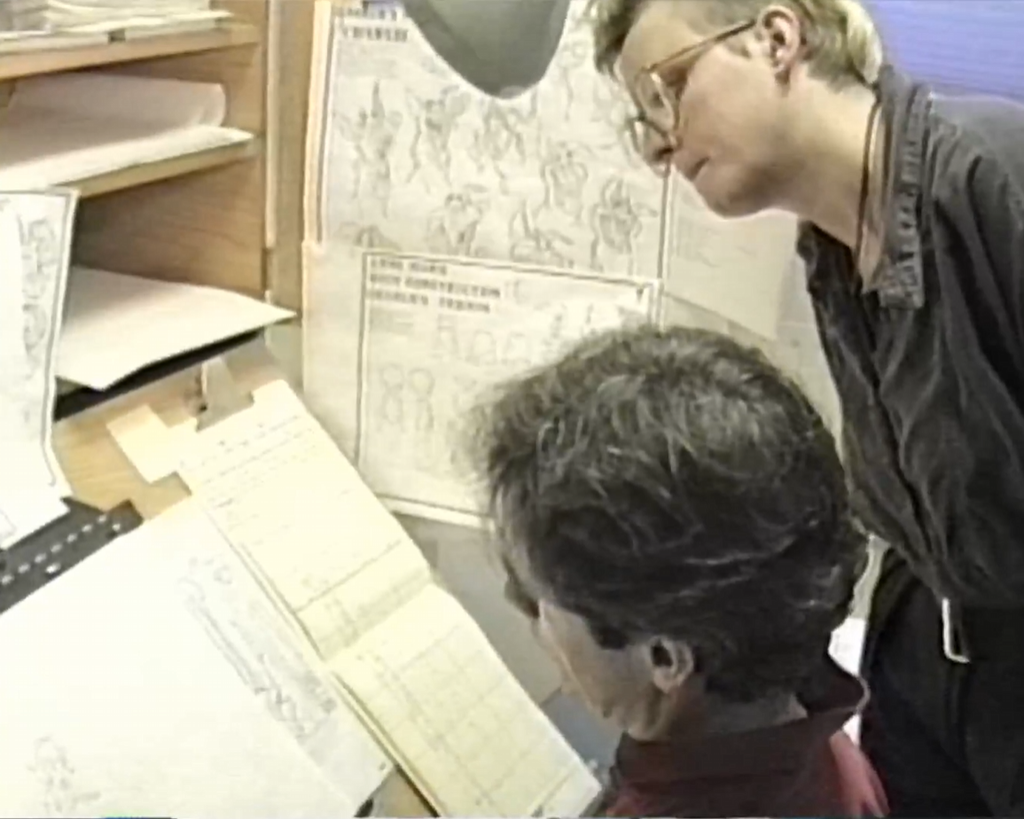
We then cut to John’s room on the 5th floor of the Irish studio, where he reviews one of Wendo’s clean‑up drawings. John walks the team through his notes, explaining the best way to approach Anne‑Marie’s line work. He demonstrates the delicate use of the kneaded eraser — just enough to gently soften the animator’s rough without losing information — and then focuses on the design of the eyes, adding subtle structure lines and the right thickness to the eyelashes to maintain appeal.
It’s a rare behind‑the‑scenes moment from the 1988 production: a Supervising Animator speaking directly with the clean‑up crew about how to bring a character to life.
Hope you enjoy this Part 1 video.
JOHN POMEROY – ALL DOGS GO TO HEAVEN – CLEAN UP NOTES – PART 1
Show Notes :
Supervising Animator / Producer John Pomeroy at his desk Early 1986
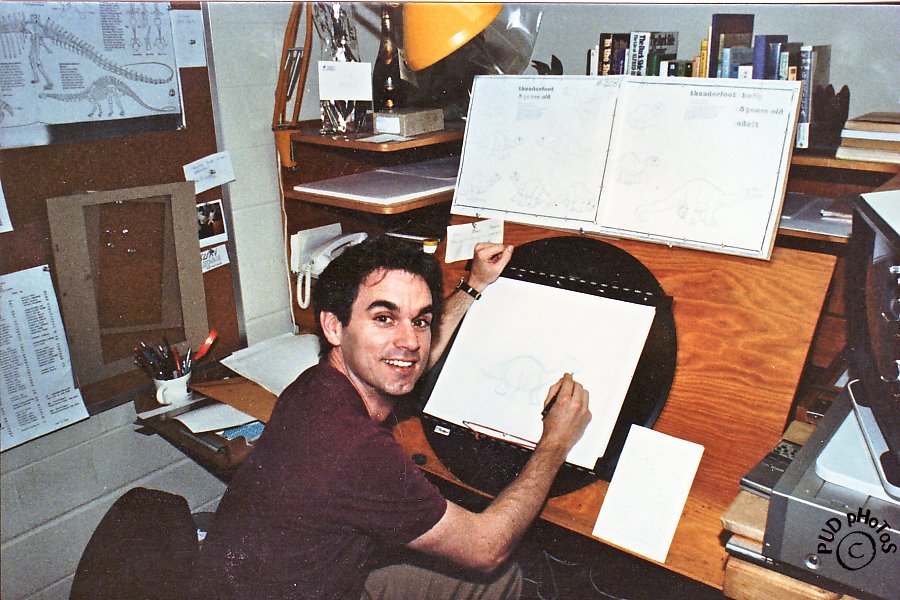
Here’s one of my photos of John at Sullivan Bluth Studios in Van Nuys, California, taken during the 1985–86 production of Don Bluth’s second animated feature, An American Tail.
Every so often during a break, I’d walk around the studio with my camera, grabbing photos or video of the artists just to document what everyday life looked like during production — the behind‑the‑scenes moments that usually disappear as everyone is so busy.
On this particular day, I knocked on John’s door and found him working on one of the main characters for the next feature about to go into production, The Land Before Time. It looks like he was developing a model‑sheet turn‑around for the character then known as Thunderfoot — who audiences would later come to know as Littlefoot.
John Pomeroy Links :
Pomeroy Art Academy > LINK
Pomeroy Art Academy YouTube channel > LINK
Pomeroy Art Academy Instagram Link > LINK
John Pomeroy Art – Instagram > LINK
John Pomeroy Online Store > LINK
John Pomeroy IMDB > LINK
John Pomeroy LinkedIn > LINK
All Dogs go to Heaven ‘ Anne Marie ‘ Key Clean Up Crew :
Ashley McGovern – Character Key Clean-up Artist : IMDB > LINK
Wendo Van Essen – Character Key Clean-up Artist : IMDB > LINK
Helen Lawlor – Character Key Clean-up Artist : IMDB > LINK
Eileen Conway – Character Key Clean-up Artist : IMDB > LINK
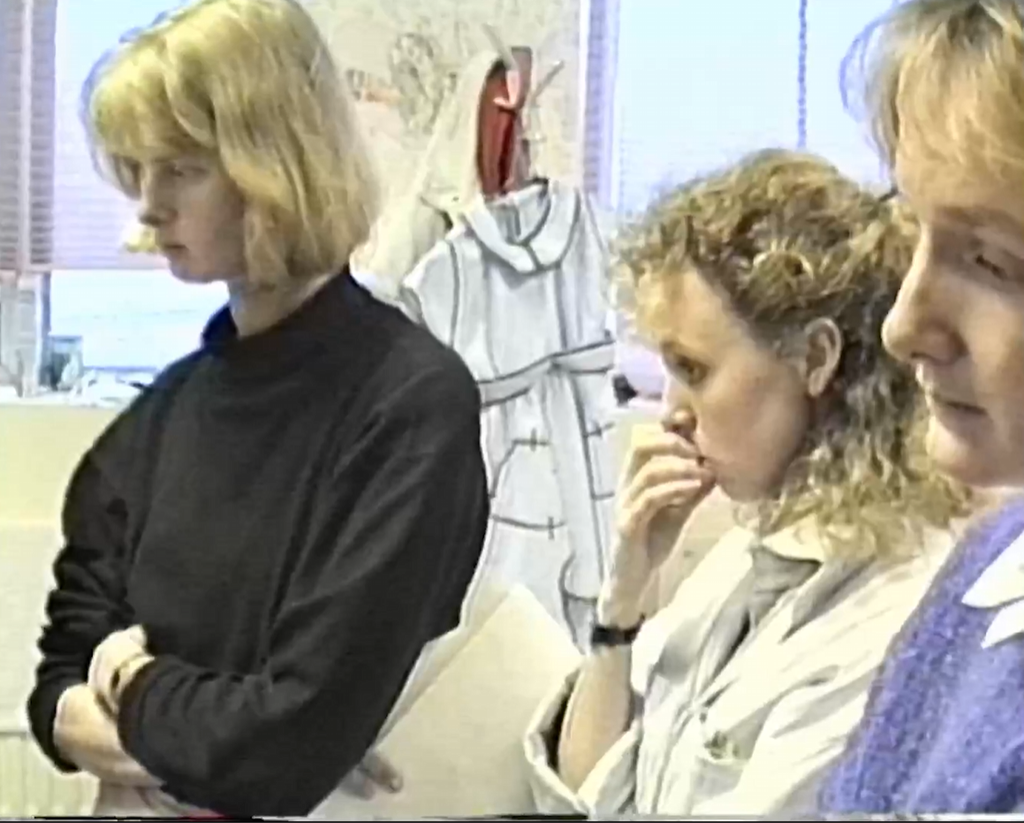
Character Key Clean-up Artist Wendo Van Essen talks over one of her drawings with Supervising Animator / Producer John Pomeroy
as the other ‘ Anne Marie ‘ Key Clean-up Artists
Eileen Conway, Ashley McGovern and Helen Lawlor look on.
‘ Cleaning up Animators drawings ‘
Note from Producer Gary Goldman
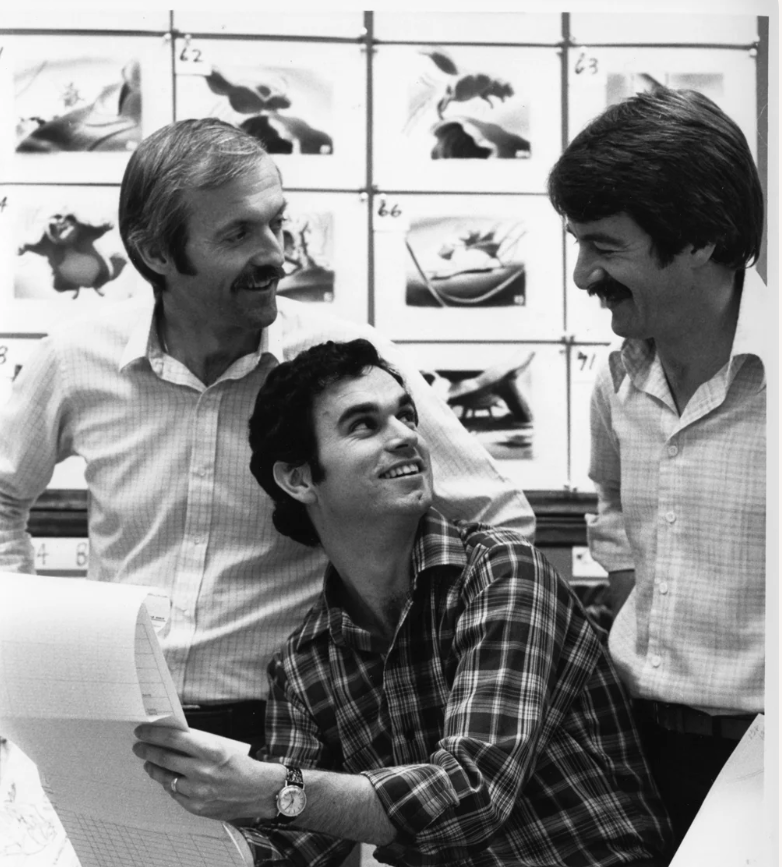
Don Bluth / John Pomeroy / Gary Goldman – early 1980s
I asked Gary Goldman [ who is the Producer and co-director of Don Buth Animation … as well as Mathieu’s Great Uncle 🙂 ] about the reason for ‘ cleaning up ‘ onto the original animators drawings while working at Don Bluth Studios. Below is his response and he mentioned that it was fine to post :
Cleaning up the animator’s ruff animation on separate paper wasn’t budget related. It’s the way we were trained at Disney during the ’70s under Woolie, Milt, Frank, Ollie, John Lounsbery and Eric Larson. They drummed it into our heads to knead down the animator’s ruff drawings and cleanup them up on the same page. We had always cleaned up the original animator’s drawings, otherwise the result is sort of a weak, fine-line tracing of the original. I believe that the reason Disney started cleaning up on a new paper was to preserve the original ruff, in case cleanup artists might have changed something that the animator or the director did not like and wanted to review the originals to make the correction. Our philosophy has always been that a cleanup on a separate piece of paper was a mere tracing of the original and lacked the power or essence of the animator’s work.
I was once the victim of poor cleanup on an 18 foot, multi-level scene with Bernard, Bianca, Evenrude and the leaf boat during production on The Rescuers, where the final version was stiff, and off model. It was heartbreaking for me, but I still believe that the originals should be cleaned up unless, of course, the originals are so far off model, or too ruff, or so darkened with a 6B pencil making is almost impossible to clean up the those drawings.
If you ever had a chance to check scenes out of the Disney morgue ( archive ), from Snow White, Pinocchio, Bambi, or any of the classics and even up thru Pete’s Dragon and The Fox and the Hound, the originals were always cleaned up on the same paper. Except maybe for Glen ( Keane ), who drew in a very heavy, sketchy style that the cleanup artist may have been too intimidated to take a chance on choosing which line Glen intended for the action. Glen always came up with some very powerful images, and the ruffs are probably still there in the morgue to prove it.” – Gary Goldman
A Post from my old BLOG regarding Clean Up Notes From John :
Late 1987 – Dublin Ireland
My Clean Up Supervisor Vera Pacheco was leaving Don Bluth Studios in Ireland to join the Disney production of ‘ Who Framed Roger Rabbit ‘ in England. She mentored and promoted me to fill in her position as Clean-Up Supervisor for the next Don Bluth feature ‘All Dogs Go To Heaven‘.
It was a great opportunity working at the level of supervisor, being responsible for keeping the Quality of the Clean Up art work as well as producing the needed footage for each weeks quota. It was also very much a learning experience being apart of the weekly production meetings learning how the business side of things worked dealing with the pressures etc.
I still remember a few times where Don would point at me and ask where the numbers were.
I always had to explain any reasons if and why the department was behind, any issues with certain scenes etc. I learned from Vera that sometimes adding a few extra artists on one scene for the end of the week push could help fill in some gaps every now and then.
Art and business. Always lots of pressure but very fulfilling when you get the needed numbers for the week and the director comments on how good a job your department is doing with the Quality of work.
Being new at the position I thought I might create some notes that could help the Clean-Up Artists as they got to learn this new film with the new characters.
So I asked the studios Leading Supervising Animator JOHN POMEROY if it was ok that i borrow a few moments of his time for him to go over some drawings every now and then.
John led the animators with his beautiful sense of appeal and design in his drawings. If you know this BLOG you’ll know I frequently post his work.
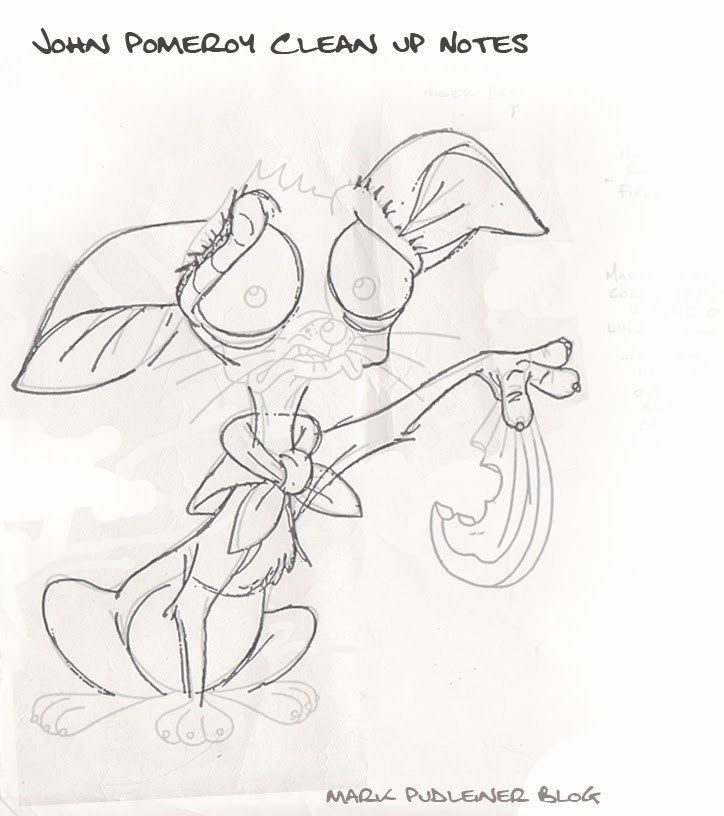
John really liked the Idea so once we were able to meet with our schedules I went up to his room and watched over his shoulder as he would draw over a Key clean up drawing from one of my Key Artists. He would be explaining to me the reason for each change. I scribbled down his thoughts as he continued looking over the drawing.
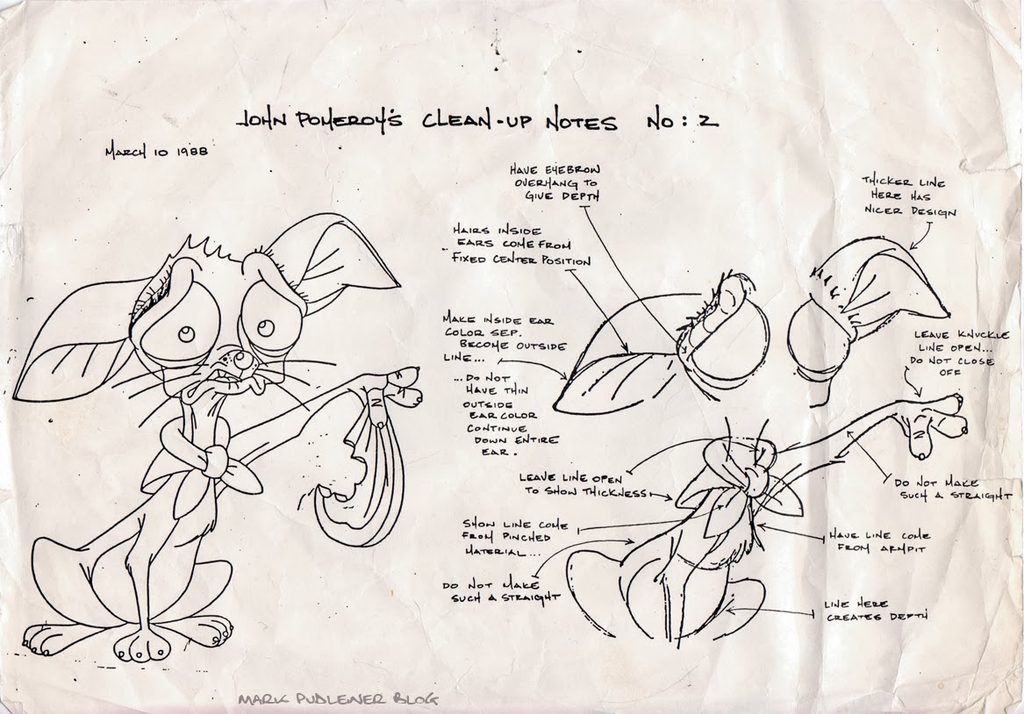
Once back in my room I would put together a hand out note that i would then give to each artist in my department.
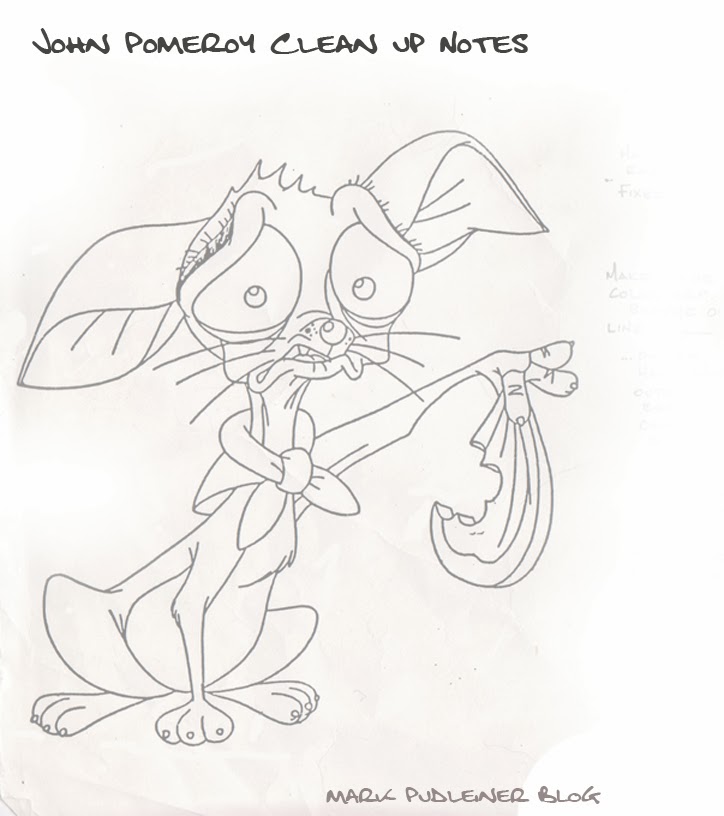
Below are the BEFORE drawing and the Pass showing John’s drawn changes.
At the very bottom is the actual hand out showing the side by side differences as well as the notes that i wrote down explaining what John had told me while he was going over the drawing.
The Original Artist Key Clean-up Drawing :
John’s drawover sketch showing how he would make changes to the Clean Up :
The side by side showing the original with the changes.
I added all the notes John discussed while going over the drawing.
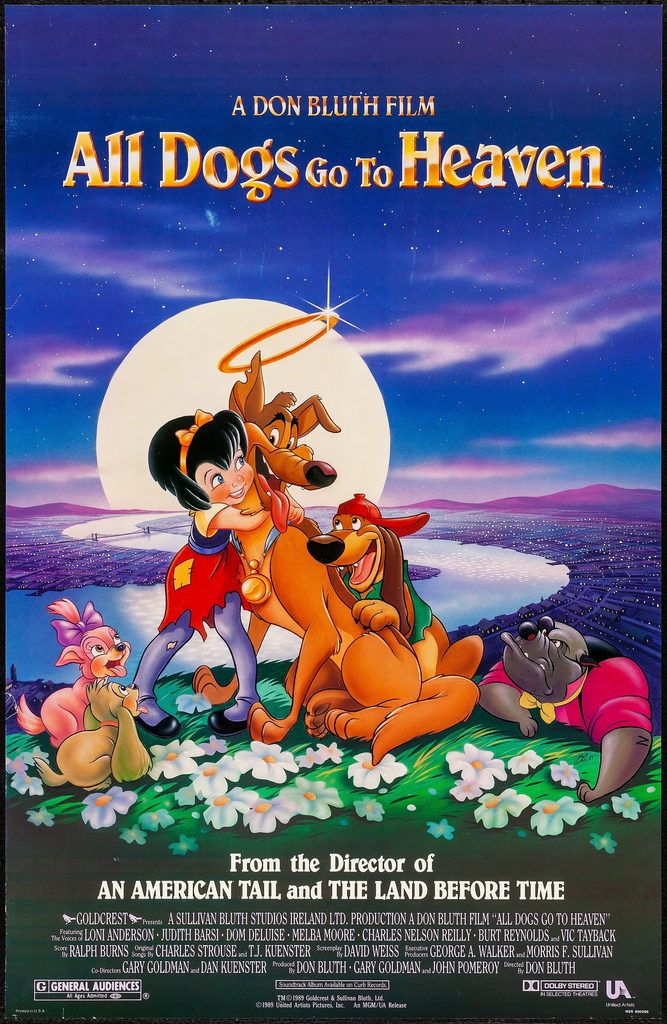
All Dogs go to Heaven : Entire Crew Credits > LINK
COMPARING THE THEMES
OF THE BOOK VS. THE FILM
Question : Was Don bluths animated feature ‘ All Dogs go to Heaven ‘ based on the book by Beth Brown. All Dogs Go to Heaven. New York: Arco Co., 1943. First edition ?
Beth Brown. All Dogs Go to Heaven. New York: Arco Co., 1943. First edition.
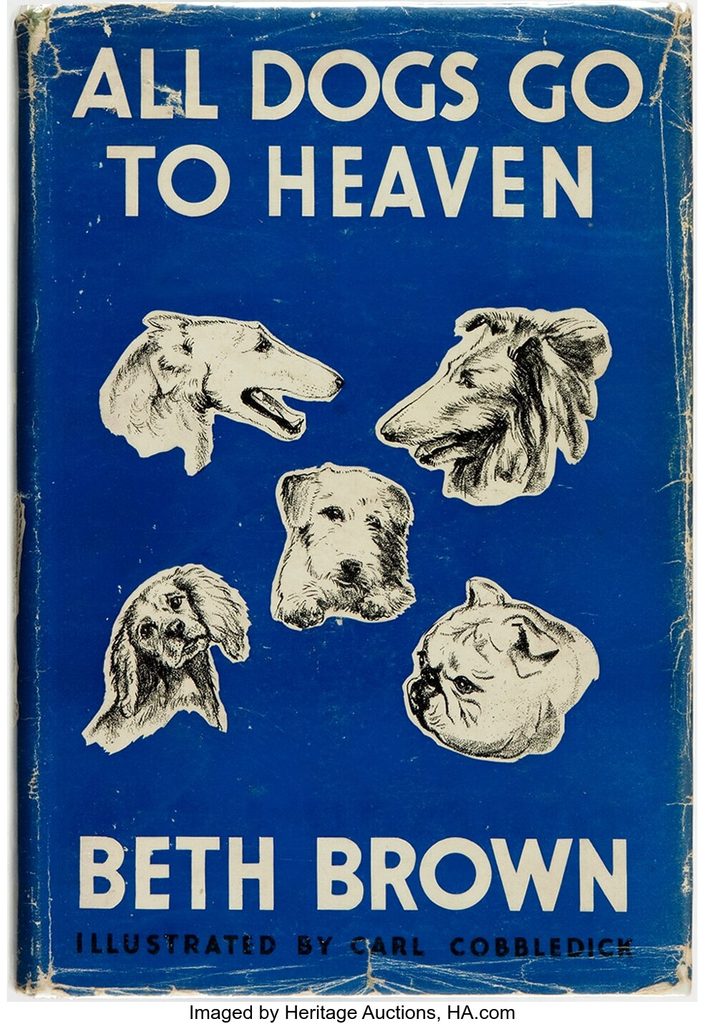
Short answer: No — All Dogs Go to Heaven (1989) was not based on Beth Brown’s 1943 book All Dogs Go to Heaven. The Don Bluth film is an original story created inside the Bluth/Sullivan Bluth studio, with no documented connection to Brown’s book beyond the coincidental shared title.
Reference helped gathered using Microsoft co-pilot
Core takeaway: Beth Brown’s All Dogs Go to Heaven (1943) and Don Bluth’s All Dogs Go to Heaven (1989) share a title and a broad spiritual premise, but their themes, tone, and narrative purpose are fundamentally different. Brown’s book is a mystical, philosophical collection of dog stories; Bluth’s film is a redemption‑arc gangster fantasy with emotional stakes, moral growth, and darker psychological undercurrents.
What the Bluth film was actually based on
The 1989 animated feature was developed from an original story by:
- Don Bluth
- Gary Goldman
- Dan Kuenster
- Larry Leker
- Linda Miller
- Monica Parker
- John Pomeroy
- Guy Shulman
- David Steinberg
- David N. Weiss
The film’s story foundation is a mix of:
- 1930s gangster‑film tropes
- A redemption arc inspired by A Christmas Carol
- A reincarnation/heaven motif that Bluth had explored in earlier concepts
- A dog‑centric twist on noir themes (gambling, betrayal, revenge)
There is no mention in any production notes, interviews, or copyright filings of Beth Brown’s book being used, referenced, optioned, or adapted.
What Beth Brown’s 1943 All Dogs Go to Heaven actually is
Beth Brown’s book (Arco Publishing, 1943) is a short, sentimental prose work about the idea that dogs possess souls and therefore go to heaven. It’s essentially a reflective, philosophical piece — not a narrative, not a children’s adventure, and not a plot-driven story with characters, villains, or conflict.
Key traits of the book:
- No characters resembling Charlie, Carface, Itchy, Anne‑Marie, etc.
- No gambling, crime, redemption arc, or “return from heaven” storyline.
- No plot structure that could be adapted into the Bluth film.
- It’s a thematic meditation, not a story suitable for direct adaptation.
The only overlap is the title and the general idea that dogs can go to heaven.
Beth Brown’s All Dogs Go to Heaven (1943) and Don Bluth’s All Dogs Go to Heaven (1989) share a title and a broad spiritual premise, but their themes, tone, and narrative purpose are fundamentally different. Brown’s book is a mystical, philosophical collection of dog stories; Bluth’s film is a redemption‑arc gangster fantasy with emotional stakes, moral growth, and darker psychological undercurrents.
1. Core Theme: What “Heaven” Means
Beth Brown (1943)
- Heaven is a universal, comforting afterlife where all dogs continue to exist joyfully.
- The book emphasizes continuity of spirit: dogs never truly die; they remain with us in another form.
- It’s a philosophical reassurance for dog lovers.
Don Bluth (1989)
- Heaven is a moral destination but not guaranteed; Charlie earns redemption through change.
- The afterlife is part of a character arc, not a universal promise.
- The film uses heaven to explore guilt, consequence, and transformation.
Contrast: Brown treats heaven as an absolute truth for all dogs; Bluth treats it as a moral framework for storytelling.
2. Tone & Emotional Purpose
Beth Brown
- Tone is mystical, tender, wistful, patriotic, and uplifting.
- Stories are meant to comfort, inspire, and offer gentle spiritual philosophy.
- Even when dogs “die,” the tone remains reassuring, never dark.
Bluth
- Tone is dark, emotional, and sometimes frightening.
- Includes betrayal, murder, revenge, nightmares, and moral reckoning.
- The emotional purpose is catharsis: confronting loss, guilt, and letting go.
Contrast: Brown’s book comforts; Bluth’s film challenges.
3. Themes of Morality & Growth
Beth Brown
- Dogs are inherently good; their afterlife is unconditional.
- Moral lessons are gentle: miracles, kindness, dreams, companionship.
- No character undergoes a dramatic moral transformation.
Bluth
- Charlie begins as a self‑serving hustler; his arc is about learning love and selflessness.
- Redemption is earned through sacrifice, especially his bond with Anne‑Marie.
- The film stresses that second chances matter, but sometimes come too late.
Contrast: Brown’s dogs are spiritually complete; Bluth’s protagonist must become good.
4. Themes of Loss & Letting Go
Beth Brown
- Loss is softened: dogs never truly leave; they remain spiritually present.
- The book’s message: your dog is still with you.
Bluth
- Loss is painful and central: Charlie must say goodbye to Anne‑Marie.
- The film acknowledges grief, separation, and the finality of death.
Contrast: Brown denies the finality of loss; Bluth confronts it.